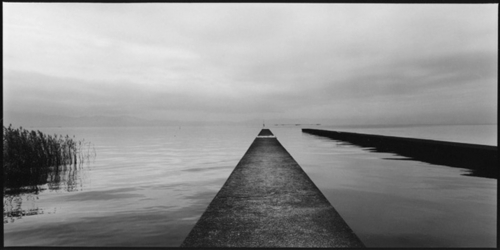
Photography could be said to date back to the late 10th century, with the invention of the camera obscura (and even further back to the pinhole camera). With the discovery of silver nitrate, silver chloride, and with experimention in light and chemical reactions, the stage was set for the usable process of photography. French inventor Louis Daguerre developed the daguerreotype at approximately the same time that William Fox Talbot was doing similar experiments in England.
Many inventors added to each other's findings, and it was Alexander Wolcott who, in 1840, received the first American patent in photography. Since then, black and white photography has changed the face of art and established an entirely new way of seeing in the arts and media.
Photojournalists like Capa, Eisenstadt, and Bourke-White caught the public imagination with their black-and-white images of the world. And art photographers like Henri Cartier-Bresson and Ansel Adams drew our attention to the forms and shapes of nature, set into high contrast through monochrome.
For over 60 years, all photographs were in black and white but by 1903 the technology to create color photos had developed, relegating black and white photography to a new role. Despite the popularity of color, black and white photography remained coveted and honored, delivering a unique authority and beauty to art photography and documentary photography. It is also cost-effective and a good teaching tool which is why photography students still cut their teeth in black and white photo labs.