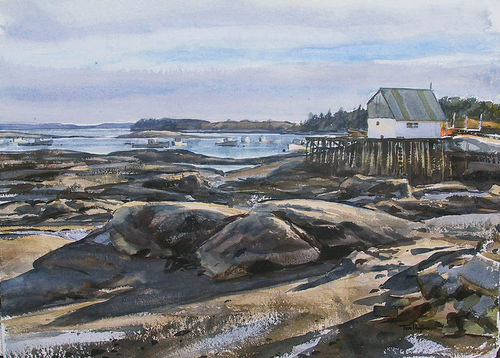
Imagine the waterfront in Paros, Greece...cobalt blue water, the soft dabs of sky. The bright flowers and white sidewalks winding to houses with curved rooftops. Can you imagine any medium more perfect than watercolor for capturing this scene?By suspending colorant in a water-soluble liquid, watercolors create, as might be expected, a thin, clean pigment that rests tight against many surfaces such as the paper, papyrus, plastic, vellum, leather, fabric, canvas, and wood. Painting with watercolor has an elemental quality evidenced by its longevity in human history and its use as a beginner's medium. The earliest cave painting of Paleolithic Europe were versions of watercolor. And many children begin their experiments in painting with a watercolor set: a flimsy white plastic tray embedded with bright pods of color that they learn to dab a wet brush into and then slosh onto nearby paper.Despite its ease of use for beginners, the medium also offers great precision and depth for advanced artists. The ancient Chinese used monochrome watercolors used for brush painting and scroll painting. They passed the medium into India and Ethiopia and Japan, but it wasn't until the Renaissance that watercolors were used to paint botany, wildlife, and landscapes. For a long while after, watercolors were widely fashionable as travel documentation.. Watercolors lost some popularity when it was discovered that the pigments did not archive well. Now that they have been made more durable, there has been a resurgence of the popularity and prestige of watercolor.Some famous watercolorists include the poet William Blake, who created large works in watercolor; Wassily Kandinsky, Paul Klee, and Maurice Prendergast; and John Singer Sargent, considered by many the finest watercolor painter of all time.