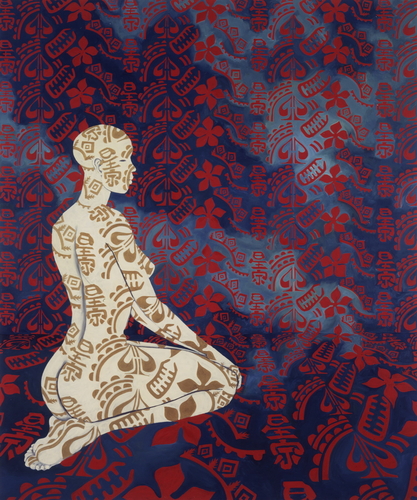
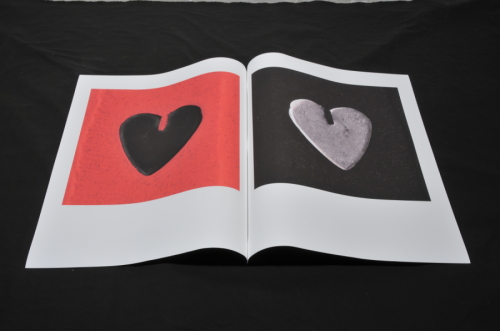
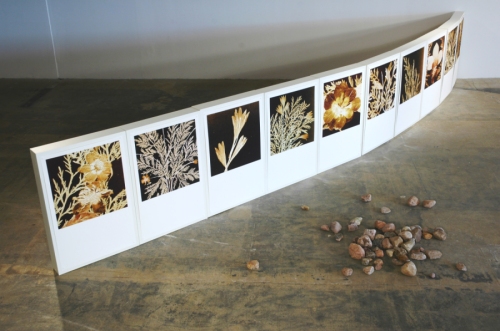
Printmaking is the process of producing “multiple originals” of an original artwork on to a support surface. Printmaking as a fine art is not the same as “making prints;" mechanical reproductions of artwork through an ink jet printer. Instead of manufacturing duplicates, the artist creates more than one original print from a single original surface or a matrix. Matrices can be made of copper, zinc (etching), stone (lithography), blocks of wood (woodcuts), linoleum (lino cuts), fabric (silk screen), or other materials. The images are then reproduced on paper, fabric, parchment, plastic, or other support surfaces through a process of printing. Monotyping follows a similar process but produces only one unique print.The notion of printmaking can be traced back to the earliest stencils on cave walls. Later on, around 500 BC, Japanese artists created stencils using paper and human hair. Woodcutting appeared in China as early as the fifth century AD. The arts that comprise printmaking such as silk screening, engraving, etching, wood cutting, and lithography, continued to evolve mostly in Asia and Europe throughout the following centuries. They have become important to both industry and artistic experiment in the past century. Some of the most recognizable names in Western art history were fine printmakers, such as August Rodin, Edvard Munch, Andy Warhol, Albrecht Dürer, and M.C. Escher.